Emergency Mobile Welding in Dallas–Fort Worth
Mobile Welding, Emergency Welder, Dallas Welding Services, Fort Worth Welding, On-site Welding, Welding Repair
Emergency Mobile Welding Services in Dallas–Fort Worth: When to Call a Mobile Welder and What to Expect
In a region as busy and infrastructure‑driven as Dallas–Fort Worth, a failed weld can shut down an entire operation. Emergency mobile welding services help businesses and public agencies get critical assets back online fast—without the delay and logistics of hauling equipment to a shop.
Why Mobile Welding Matters for Dallas–Fort Worth Businesses and Agencies
The Dallas–Fort Worth metroplex runs on steel, aluminum, and heavy equipment. From distribution centers and trucking yards to municipal facilities, utilities, and construction sites, welded components hold together the structures and machinery that keep the region moving. When those welds fail, the impact is immediate: halted production lines, out‑of‑service vehicles, unsafe structures, and potential regulatory exposure.
Traditional shop‑based Dallas welding services are ideal for planned fabrication and non‑urgent work. But in an emergency, disassembling and transporting a damaged gate, trailer, or structural member can be impractical—or impossible. Mobile welding brings the equipment, expertise, and materials directly to your location, allowing a certified emergency welder to assess and repair the problem on site, often within hours of your call.
When to Call a Mobile Welder: Common Emergency Scenarios
Knowing when to call a mobile welder can be the difference between a brief interruption and a prolonged shutdown. Below are typical situations where businesses and agencies across Dallas and Fort Worth rely on emergency mobile welding services.
1. Structural Damage That Compromises Safety or Access
If a structural element is cracked, bent, or broken, it can quickly become a safety hazard. Common examples include:
Damaged handrails, guardrails, or safety barriers in warehouses, parking garages, or stadiums
Bent or broken steel stairs, platforms, and mezzanines in industrial facilities
Impact damage to gates, fences, and access control structures at distribution centers or municipal yards
In these situations, shutting down an area until repairs are made may be required by safety policies or OSHA guidelines. On‑site welding allows a Fort Worth welding or Dallas welding services team to stabilize and repair the structure quickly, often restoring safe access the same day.
2. Equipment and Vehicle Failures That Halt Operations
For logistics, construction, and public works departments, equipment uptime is critical. A cracked trailer frame, broken loader bucket, or damaged truck bed can take an asset offline at the worst possible time. Common emergency welding repair needs include:
Trailer frame and axle bracket repairs for fleets and freight carriers
Skid‑steer, backhoe, and excavator bucket cracks or edge replacements on construction sites
Dump truck body, lift gate, and hitch repairs for municipal or private fleets
Calling an emergency welder who can meet you at your yard, jobsite, or roadside location reduces towing costs and gets critical equipment back in service faster. For many operators, the cost of downtime far exceeds the cost of a prompt mobile welding repair.
3. Time‑Sensitive Facility and Infrastructure Repairs
Public agencies and facility managers often face issues that must be resolved quickly to maintain operations or meet regulatory requirements. Examples include:
Emergency repairs to water treatment plant components, grates, and access ladders
Rapid modification or reinforcement of structural supports during renovations or inspections
Urgent fixes to loading docks, bollards, or canopy supports after vehicle impact
In these cases, on‑site welding eliminates the delay of removing and transporting heavy or embedded steel components. A mobile welding unit can arrive with generators, welding machines, and fabrication tools to complete repairs in place, often working around your operating schedule to minimize disruption.
4. After‑Hours and Weekend Incidents
Not every failure happens between 8 and 5. Many Dallas welding services and Fort Worth welding providers offer 24/7 emergency response, allowing you to address problems that occur overnight, on weekends, or during holidays. This is particularly valuable for:
Retail and hospitality venues that need repairs completed before opening hours
Manufacturing plants running multiple shifts or continuous processes
Municipal and utility operations that must maintain service around the clock
💡 Pro Tip: If a failed weld could cause injury, block access, or shut down a revenue‑generating operation, treat it as an emergency and contact a mobile welder immediately.
What to Expect When You Call an Emergency Mobile Welder
Understanding what to expect from emergency mobile welding services helps you prepare your site, communicate clearly, and control costs. While each provider has its own process, most professional mobile welding companies in Dallas–Fort Worth follow a similar sequence from the first phone call to job completion.
1. Initial Call and Problem Assessment
When you contact an emergency welder, be prepared to provide as much detail as possible. This allows the welder to determine whether the issue can be addressed with mobile equipment, what materials are needed, and how urgent the response must be. Expect questions such as:
What exactly is damaged? (e.g., trailer frame, structural beam, handrail, heavy equipment bucket)
What material is involved—carbon steel, stainless steel, aluminum, or another alloy?
Where is the asset located, and how accessible is it for a welding truck and equipment?
Is the damage strictly cosmetic, or does it affect safety, structural integrity, or operations?
Photos or short videos sent by text or email are extremely helpful. They allow the mobile welding provider to estimate time, materials, and whether additional crew members or equipment will be required. For larger organizations, this is also the stage to confirm billing details, purchase order requirements, and any site‑specific safety orientations.
2. Response Time and Dispatch Across DFW
In a metro area as large as DFW, response times can vary based on location, traffic, and current workload. Many Dallas welding services and Fort Worth welding providers quote a typical emergency response window—often between one and four hours within the core metro area, with longer times for outlying communities. Clarify:
Estimated arrival time based on your address and the urgency of the repair
Whether after‑hours or weekend rates apply
Any travel or mobilization charges for distant or hard‑to‑access sites
Professional mobile welding trucks are essentially rolling shops, equipped with generators, welders, cutting torches, grinders, clamps, and commonly used steel shapes and consumables. When the truck arrives, the goal is to perform a complete welding repair in one visit whenever possible.
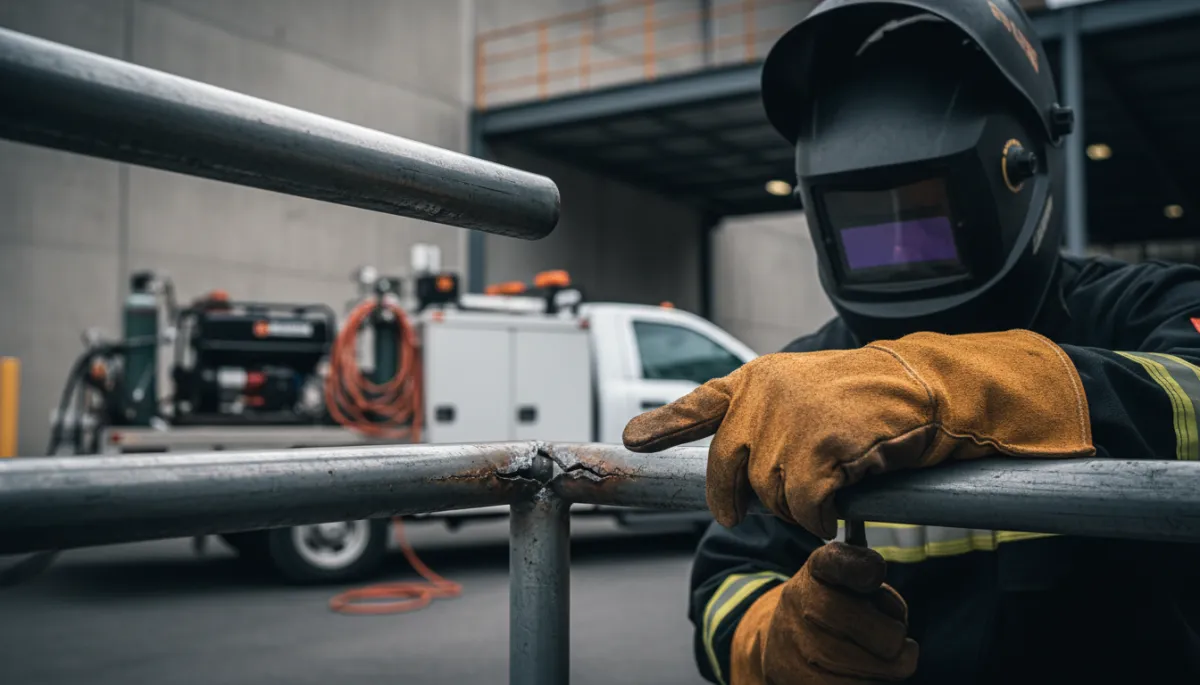
A thorough on-site inspection ensures the repair plan addresses safety and code requirements.
3. On‑Site Inspection, Safety, and Work Plan
Upon arrival, the welder will inspect the damaged area in person. This step is critical: what looks like a simple crack in a photo may reveal hidden distortion, fatigue, or corrosion when viewed up close. Expect the welder to:
Evaluate the full extent of the damage, including adjacent welds and supporting members
Identify the base metal (steel, stainless, aluminum) and thickness to select the proper process and filler
Discuss access, fire watch, and any required shutdowns or isolation with your team
Safety is a shared responsibility. Welding produces heat, sparks, and fumes. A reputable mobile welding provider will follow safety protocols, including PPE, fire extinguishers, and shielding. Your team may need to:
Clear the work area of flammable materials and unnecessary personnel
Provide access to the site, including badges, escorts, or lift equipment if needed
Coordinate with your safety or facilities team to comply with internal procedures
📌 Key Takeaway: The more clearly you communicate site hazards and access limitations, the smoother and safer the on‑site welding process will be.
4. Repair Options, Pricing, and Approvals
After inspection, the welder will typically present one or more repair options. These may range from a quick temporary fix to a more robust, long‑term solution. For example, a cracked support might be:
Ground out and rewelded to restore original strength
Reinforced with additional plates, gussets, or bracing to exceed original capacity
Temporarily stabilized until a full replacement can be scheduled
Expect transparent discussion of labor rates, minimum service charges, material costs, and any surcharges for emergency or after‑hours work. Many Dallas welding services can provide a not‑to‑exceed estimate on site, which is especially important for agencies and larger businesses that must obtain approval before proceeding.
5. Performing the Welding Repair On Site
Once authorized, the welder will set up equipment and begin the welding repair. Depending on the job, they may use processes such as stick (SMAW), MIG (GMAW), or TIG (GTAW), each suited to different metals and conditions. Typical steps include:
Cleaning the area to remove paint, rust, oil, and contaminants that can weaken a weld
Cutting or grinding out old, failed welds to sound base metal
Fitting and clamping new components or aligning existing parts before welding
Applying welds in passes, allowing for proper penetration and heat control
For many businesses and agencies, a key advantage of on‑site welding is the ability to observe the work as it happens, ask questions, and verify that operational needs are being met—whether that means clearance for moving parts, alignment of gates, or reinforcement for future loads.
6. Inspection, Cleanup, and Documentation
After welding, the technician will inspect the finished work visually and, if required, with additional testing methods. They may grind or smooth certain areas, apply primer or paint to prevent corrosion, and remove debris from the work area. Before leaving, a professional mobile welder should:
Review the repair with your representative and confirm that function and fit are restored
Provide any necessary documentation, such as invoices, time sheets, or basic weld descriptions for your records
Note recommendations for future maintenance, reinforcement, or replacement if the damage indicates underlying issues
💡 Pro Tip: Ask your mobile welding provider to photograph before‑and‑after conditions. These images can support insurance claims, internal reports, or capital planning.
Choosing the Right Mobile Welding Partner in Dallas–Fort Worth
Not all mobile welders are the same. For businesses and agencies, selecting a reliable partner before an emergency occurs can save valuable time later. When evaluating Dallas welding services or Fort Worth welding providers that offer mobile support, consider the following factors.
Experience with Commercial and Industrial Work
Ask whether the company routinely serves commercial facilities, industrial plants, fleets, and government agencies. Experience in these environments means the welder is familiar with:
Heavier sections, structural members, and specialized alloys
Jobsite coordination with multiple trades, contractors, or departments
Documentation, invoicing, and insurance requirements common to larger organizations
Certifications, Insurance, and Safety Culture
For critical structural or code‑related work, welding certifications and proper insurance are non‑negotiable. When you’re relying on on‑site welding to restore a stairway, balcony, or load‑bearing support, you need confidence that the repair meets industry standards. Verify:
Current liability and workers’ compensation coverage at levels appropriate for your organization
Any applicable welding certifications or qualifications relevant to your project type
Commitment to PPE, fire prevention, and adherence to your site’s safety rules
Capacity for True Emergency Response
Some welding shops list “mobile services” but primarily focus on scheduled work. For true emergencies, look for a provider that clearly offers rapid response and has multiple trucks or welders available. Ask:
Typical response times for different parts of the Dallas–Fort Worth area
Whether they provide 24/7 coverage, including nights, weekends, and holidays
How they prioritize safety‑critical or operations‑critical calls when the schedule is full
Preparing Your Organization Before the Next Welding Emergency
While emergencies are unpredictable, your response doesn’t have to be. A little preparation goes a long way toward minimizing downtime when you need mobile welding support in Dallas–Fort Worth. Consider these steps:
Identify critical assets—gates, docks, structural elements, equipment—and note who is responsible for them internally.
Establish an approved vendor list that includes at least one trusted emergency welder with coverage across DFW.
Clarify internal approval processes so supervisors know how to authorize emergency welding repair work quickly.
Keep records of previous welding issues to identify patterns—such as recurring impact damage or fatigue—that may call for upgrades, not just repairs.
📌 Key Takeaway: Having a vetted mobile welding partner and a clear internal playbook turns a chaotic breakdown into a manageable service call.
Bringing It All Together: When to Call and What to Expect
For businesses and agencies in Dallas–Fort Worth, emergency mobile welding is not just a convenience—it’s a strategic tool for protecting people, assets, and revenue. You should call a mobile welder whenever a failed or damaged weld:
Creates a safety hazard or code compliance issue in your facility or public space
Takes critical equipment, vehicles, or infrastructure out of service and disrupts operations
Cannot be reasonably transported to a shop without significant delay or added cost
When you make that call, you can expect a structured process: problem assessment, realistic response time, on‑site inspection, clear repair options and pricing, professional on‑site welding, and documented completion. By choosing a qualified provider of Dallas welding services or Fort Worth welding support and preparing your internal team in advance, you position your organization to respond quickly and confidently the next time a weld fails.
Emergencies may be inevitable, but extended downtime doesn’t have to be. With the right emergency mobile welding partner on call, your business or agency can keep critical operations running safely and efficiently across the Dallas–Fort Worth metroplex—no matter when or where the next issue arises.